Training & Facilitation
Strengthening human capabilities for working with people and AI.
Our two areas of training and facilitation focus on Communication & Collaboration and I-AI: Amplifying Human Potential with AI.
Both foster critical and reflective thinking, helping people communicate effectively, make sound judgments, and navigate uncertainty.
Every learning journey is unique. Our programmes are tailored to each client's needs, combining practical training, constructive dialogue, and reflection.
Service 01
Communication & Collaboration
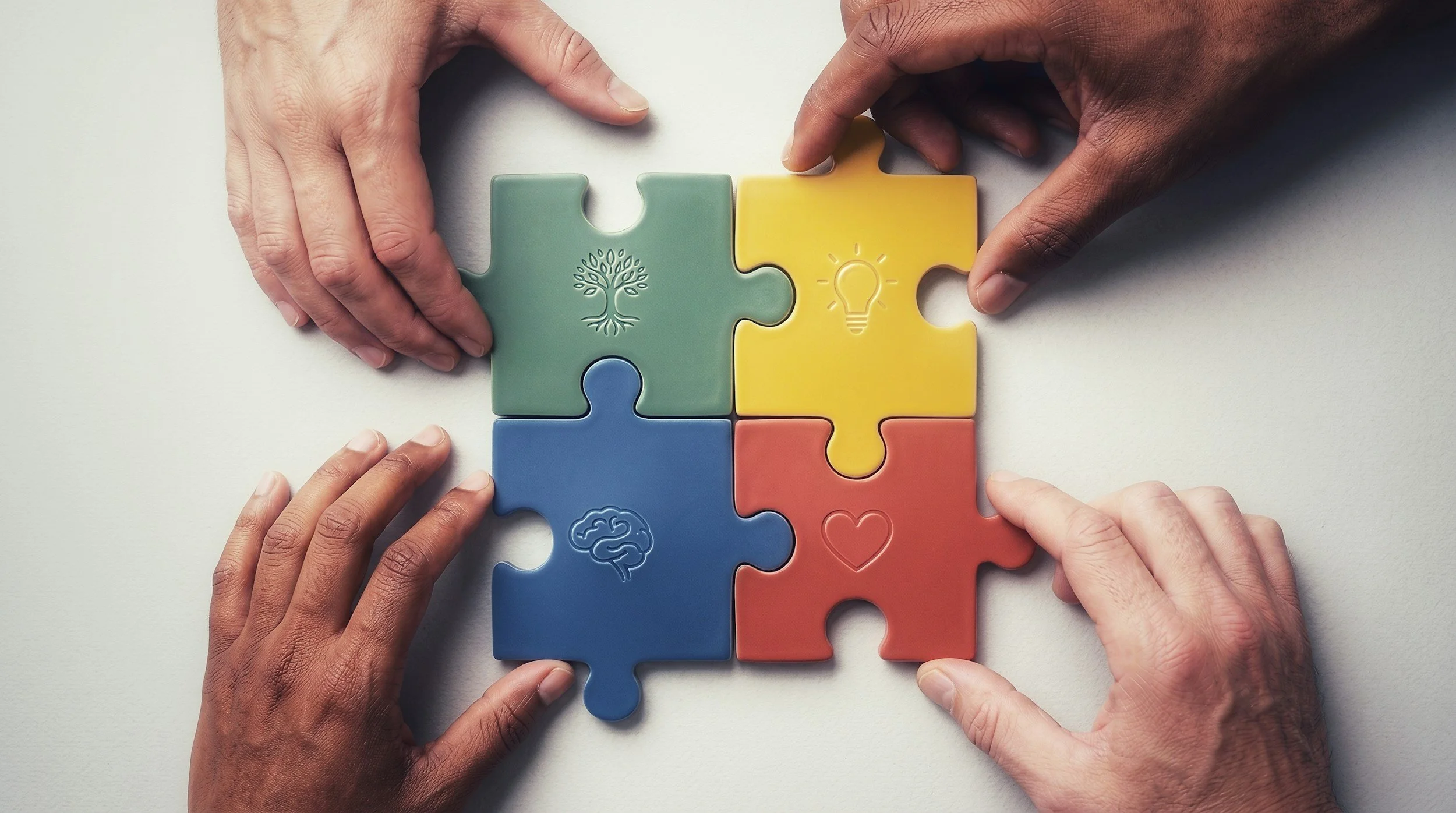
Great individuals can achieve great things. Together, they can achieve even more.
Successful collaboration doesn't happen automatically. It requires recognising different perspectives, navigating disagreements constructively, and building trust in an environment where everyone is treated with respect.
Dauwels & Co. offers training and facilitation across four key areas for professionals, teams, and organisations.
-
Effective communication starts with understanding ourselves and others.
This training explores how our mindset and cognitive processes shape the way we perceive, interpret, and respond to others. By recognising cognitive biases, distinguishing observations from interpretations, and reflecting on communication habits, participants become more aware of their behaviour and its impact.
Depending on the learning objectives, training may focus on active listening, assertive communication, constructive feedback, or constructive discussion, with practical applications ranging from one-on-one conversations and group discussions to difficult conversations and conflict situations.
-
Understanding the bigger picture of how we work together.
Effective teamwork depends not only on individual communication skills, but also on how people, roles, and processes interact.
Drawing on systems thinking, this training explores team dynamics, communication patterns, and interconnections within and across teams. It helps identify barriers to collaboration, improve information flow, and strengthen coordination across the organisation.
-
Individual differences. Shared goals.
Creating inclusive environments starts with understanding how individual differences, personal backgrounds, and unconscious biases influence communication and collaboration.
Training explores diversity, equity and inclusion (DEI), and practical ways to foster inclusive behaviours and organisational cultures.
The aim is to create workplaces where individuals are respected while everyone works towards shared goals.
-
Creating space for open and constructive dialogue.
An external facilitator brings a fresh perspective and helps create an environment where people feel comfortable sharing ideas, discussing differences, and addressing complex issues.
Dauwels & Co. provides independent facilitation for teams and organisations, supporting constructive dialogue, collective reflection, and collaborative decision-making according to their needs.
Service 02
I-AI: Amplifying Human Potential with AI
Think deeper. Work smarter. Achieve more.
Using generative AI goes beyond prompting. How we interact with AI influences the outcome—either amplifying our potential or misleading us.
I-AI strengthens our thinking, communication, and judgement to make the most of AI.
-
The quality of our questions shapes the quality of AI-generated answers.
Before asking AI, we need to be clear about what we want to know or achieve. This starts by asking ourselves: What do I already know? What am I unsure about? What am I assuming? What am I really trying to find out?
I-AI encourages self-reflection to uncover gaps in understanding, challenge assumptions, and explore different ways of framing questions before deciding what to ask AI.
-
How we communicate influences how AI responds.
Effective communication with large language models (LLMs) requires more than choosing the right words. It involves organising ideas logically, providing relevant context, and adjusting the level of detail and abstraction to suit the purpose.
I-AI strengthens the ability to turn complex thoughts into clear, structured messages that convey our intentions and guide AI towards more relevant responses.
-
Pause and think before moving on.
AI-generated responses can offer useful insights, but may also contain errors, unsupported assumptions, or overlooked perspectives.
I-AI draws on established thinking approaches, including critical, analytical, and creative thinking, to examine evidence, challenge assumptions, and explore alternative perspectives. Through iterative dialogue with AI, we can refine ideas, test different interpretations, and deepen our understanding.
-
AI informs. Humans decide.
Generative AI can help us explore options and anticipate possible outcomes. However, its analysis is limited by the information available to it and may overlook important factors that we haven't shared.
I-AI encourages us to look at the bigger picture, consider what AI might have missed, and weigh different options in light of our own knowledge, experience, and values.
Ultimately, the judgement and responsibility remain ours.
Our Approach
Designed Around Your Needs
Every organisation has its own people, challenges, and ambitions.
We take time to understand each client's unique situation before designing a tailored training or facilitation programme.
From focused workshops and facilitated team sessions to longer learning programmes, we select and adapt learning activities, develop customised cases and exercises where needed, and connect the content to the client's real-world challenges.